Sunday, November 24, 2013

Artificial Intelligence: A Close Encounter

When the average person talks about artificial intelligence, they frequently recall 2001: A Space Odyssey, Terminator and a myriad of other movies, T.V. shows and games in which computers go against their human masters. However, what most people don't realize is that while computers aren't capable of becoming sentient and over-throwing their owners, artificial intelligence has developed to the point of becoming an effective tool for solving complex problems. I have been lucky enough to witness the power of artificial intelligence first hand!

Between June 2011 and January 2013, I worked on and off at a small start up company in my hometown. Until fairly recently, I was unable to talk about the work I did there due to a non-disclosure agreement, but now that my superior has received a patent for his good work, I am able to discuss it somewhat.

During my 1.5 year internship with Cognisense Labs, I helped improve my mentor's invention, an autonomous system for planting flower bulbs. This system consisted of an industrial robotic arm, an image capture device and a powerful computer for running my mentor's (now patented) image analysis algorithms. This system was used to locate, orient and plant flower bulbs into crates before being taken to a storage facility.


Robots and artificial intelligence are key pieces to solving the problem of eliminating the need for humans to perform dull, repetitive and sometimes dangerous tasks. Prior to working on his robotic farming endeavors, my mentor invented a driver-less mine sweeping vehicle to clean up former war-zones safely, eliminating the need for innocent people to put themselves in harms way.


Some people see artificial intelligence as death and destruction, but I see the opposite. Artificial intelligence is a catalyst for making the world a better place!

Sunday, November 17, 2013

A Brief History of the Unix Operating System

Some people may consider operating systems such as MSDOS and OS/2 to be quite old, but did you know that there is a series operating systems that has maintained popularity for over 40 years? The Unix family (along with its lengthy list of clones), despite undergoing many iterations and revisions, has remained a favorite among users and developers alike. Even those who have never heard of it may find that they are, in fact, using Unix under a different name! 

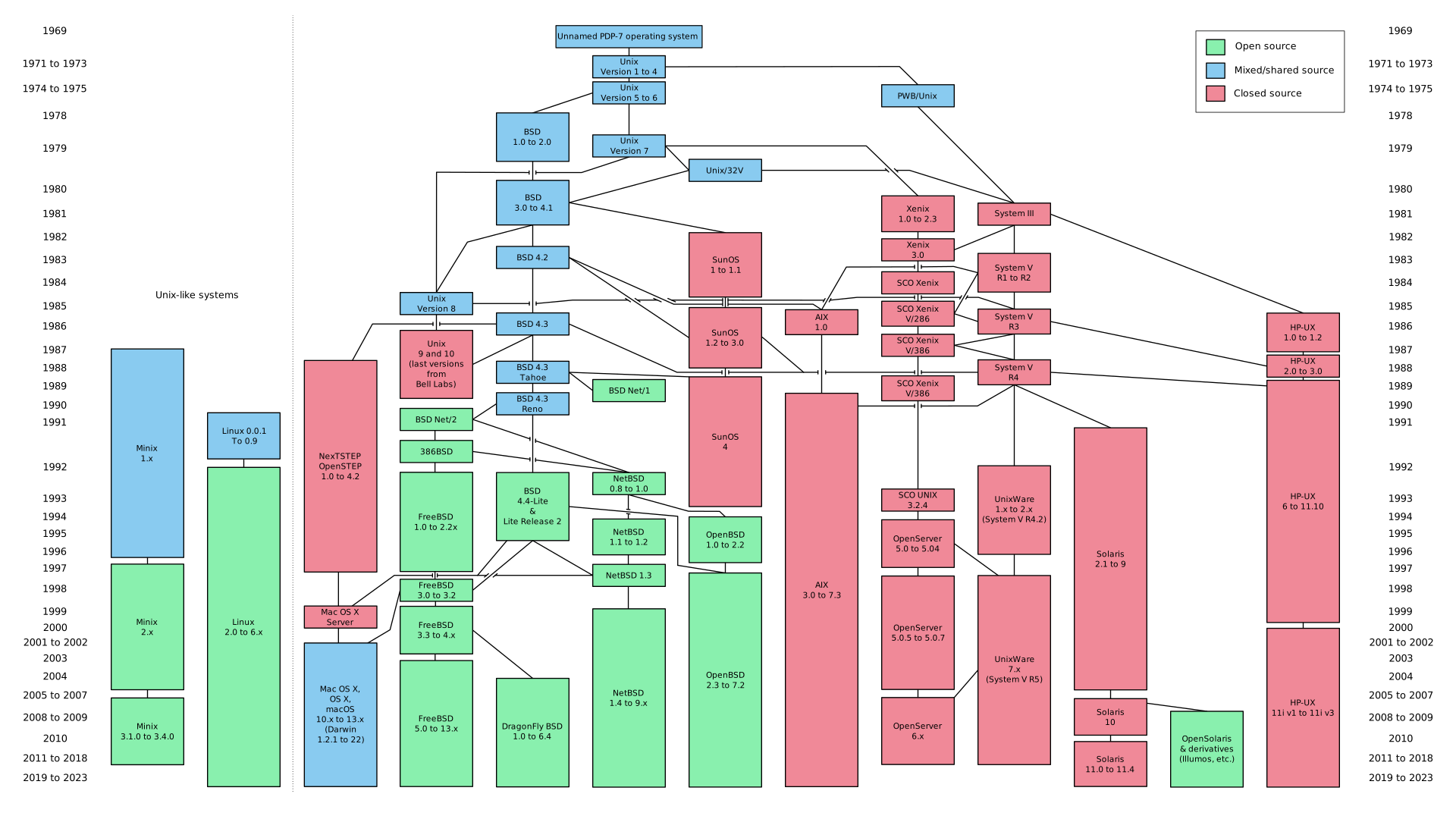
A "family photo" of Unix and its derivatives


The history of Unix began at Bell Labs in the mid 1960's. In a joint project with M.I.T, Bell Labs was developing a new time sharing operating system called the Multiplexed Information and Computing Service or MULTICS for short.[1] On the MULTICS project were two bright, young and ambitious engineers named Dennis Ritchie and Ken Thompson. Despite Ritchie and Thompson being developers of MULTICS, they did not agree with the design principles behind it. MULTICS was large and over complicated. Frustrated with the system's design flaws, Ritchie and Thompson began to write their own operating system on an old, unused PDP-7. They called their system UNICS, which stood for UNIplexed Information and Computing Service. This was a playful jab at the unnecessary complexity of MULTICS (Unixplex being a nonsense word).[2] The original UNICS was finished in 1969 and the name was changed to Unix TSS (Time Sharing System) shortly after. 

Dennis Ritchie and Ken Thompson programming on a tele-type console in the 1970's


The new system was popular within Bell Labs, but it did not become popular until 1973 when Dennis Ritchie re-wrote it in the C Language. This adjustment threw the fledgling operating system into the spotlight and changed the face of operating design forever. Being re-written in C made Unix the worlds first portable operating system, which meant it was the first operating system that could run on different types of computers.

The simple, elegant design of Unix made it enjoyable to use and its portability made it cheap and easy to obtain. These qualities also made Unix an ideal system to draw inspiration from and today there are many systems that are considered to be derivatives.

From super computers to the smartphone in your pocket, Unix is everywhere and it is likely to continue to be everywhere for many years to come!


Android, Linux and Mac OSX are all derivatives of Unix

http://web.mit.edu/multics-history/ [1]
http://www.unix.org/what_is_unix/history_timeline.html [2] [3]


Sunday, November 10, 2013

File Sharing: A Brief History

In the 1970's and most of the 1980's, the Internet had a very limited audience, but file sharing was being actively partaken in. The participants, however, were not average people looking to make copies of movies and music. Instead, the primary demographic of file sharers were curious children and adults looking to learn more about the world of computers. Type-in-programs like these were often distributed with computer hobbyist magazines in hopes of perforating computer literacy and inspiring users to become programmers.

File sharing quickly graduated to more complex means of distribution, the immediate next step being downloads through bulletin board systems. In the early days of public access to the Internet, bulletin board systems (BBSs) were like a primitive forum/chat room where people could go to talk, play games and of course, share files. However, in times where download speeds were measured in “bauds per second”, file sharing over the Internet wasn't terribly practical yet.


The most recent major innovation in file sharing has of course been peer-to-peer distributed file sharing systems. Napster Is widely credited to be the first peer-to-peer file sharing network. Due to legal issues, Napster was temporarily shut down and then re-opened as a paid service.